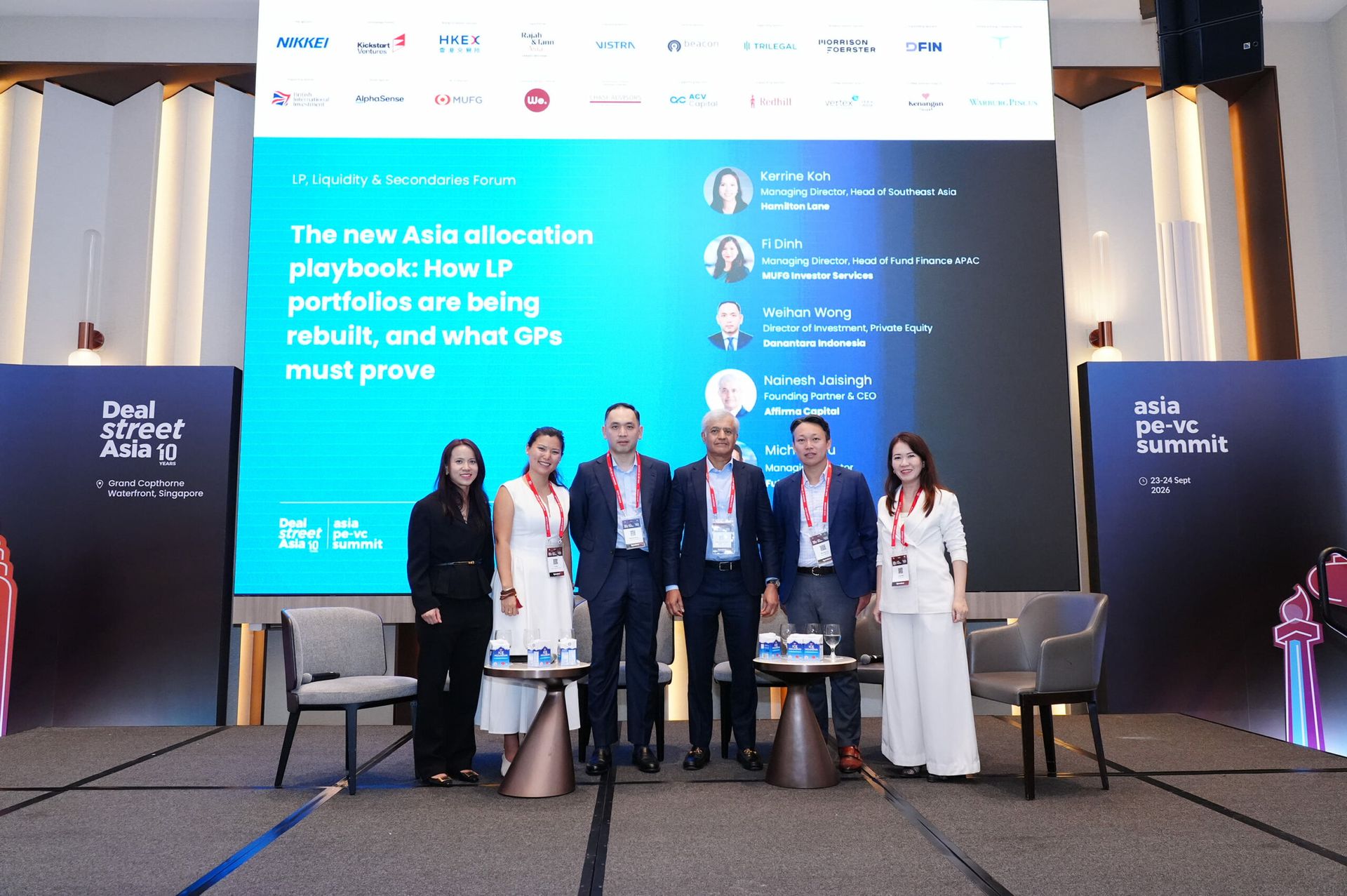
New pools of capital are emerging across Asia’s private markets, with investors taking a more strategic approach to backing the region’s investment and capital markets ecosystems.
Speaking at DealStreetAsia’s Asia PE-VC Summit 2026 in Singapore last week, Kerrine Koh, Managing Director of Client Solutions Group at Hamilton Lane, pointed to Malaysia, Singapore and North Asia as markets where such capital is beginning to emerge.
“In Malaysia, more capital is coming in to develop the VC ecosystem, while in Singapore, there are beginnings of shoring up and deepening the ecosystem around capital markets development,” said Koh.
In North Asia, some of the more strategic capital is being deployed within domestic markets for development or across the broader Asia-Pacific region, she added.
The shift is broadening the region’s LP base. Nainesh Jaisingh, Founding Partner and CEO at Affirma Capital, added that sovereign wealth funds, pension funds, insurers, family offices and retail wealth are now part of the mix. “Three or four of these were not around 10 years ago,” he said.
The pool of potential investors is extending beyond Asia too.
Fi Dinh, Managing Director and Head of Fund Finance APAC at MUFG Investor Services, said the firm had begun receiving enquiries from African pension funds and Latin American strategic investors looking at Asian funds.
“Whoever is not a friend of the US is all of a sudden a friend of Asia this year,” she said, adding “those are very interesting new sources of capital for this region.”
The shift comes against a backdrop of a more concentrated fundraising market. Mok said Asia-Pacific fundraising fell to a 12-year low last year before recovering significantly in the first half of this year to a five-year peak. However, three pan-Asian vehicles accounted for almost 85% of the region’s total.
The challenge is not simply that less capital is coming to Asia but that the capital is being concentrated among fewer GPs.
That concentration is also changing what different LPs are looking for. Michael Liu, Managing Director at Future Standard, said the firm sees three broad groups of investors approaching Asia differently.
The first comprises large LPs with global allocations that need to deploy sizeable tickets. These investors tend to favour managers with established regional teams, institutional infrastructure and the capacity to execute larger transactions, as well as opportunities to co-invest or acquire assets from GPs, Liu said.
A second group views Asia as a complement to a predominantly European or US portfolio. For these investors, Asia allocations have become smaller over the past few years, particularly since COVID19, and the number of GP relationships has narrowed. They may place greater emphasis on consistency, realised track record, team depth and the ability to navigate exits in a volatile environment, Liu said.
A third group is more opportunistic, with interest in country-specific funds and opportunities such as co-investments and secondaries.
“Interest is not dead—though it is definitely not what we saw before COVID,” Liu said.
For newer institutional investors, building an Asia allocation can begin with a fresh assessment of the region. Weihan Wong, Director of Investments at Danantara Indonesia’s second sovereign wealth fund (SWF), said they were increasingly turning their attention to the region after initially focusing on the US and other developed markets to establish its core portfolio.
“Given that we are the new kid on the block, we don’t have a legacy portfolio, existing positions or existing biases. So when we look at Asia, we look at it with a fresh pair of eyes,” Wong said.
Danantara expects to start with pan-Asian managers, alongside selective exposure to China, while targeting sectors including AI, technology, advanced manufacturing and healthcare. On strategy, Wong said the fund prefers buyouts with value-creation opportunities, while secondaries could provide an entry point into LP fund investments.
“It’s still early days for us and a work in progress,” Wong said, adding that they would continue to work with advisers to build their portfolio in Asia.
Track record matters
While there has been a move towards pan-Asian funds, Koh believes that single-country funds still present a lot of attractive opportunities, especially in the mid-market. Managers across the region, regardless of their size, describe themselves as mid-market investors. “It’s important to drill down into deal sizes” to identify who is truly operating in the harder-to-access segment, she said, which remains “very attractive” to her firm.
But accessing those opportunities remains only part of the challenge. Across Asia, and Southeast Asia in particular, there have been challenges in delivering stable DPI, even as the region continues to see tailwinds from China Plus One amid US-China tensions.
That backdrop also shapes how LPs assess track records in Asia. Track records are harder to assess in Asia than in the US and, to a lesser extent, Europe, given the region’s shorter history and fragmented markets. In the US, five decades of buyout experience have allowed firms to build long track records and specialised capabilities, while Asia spans very different regions, cultures and legal systems.
In stronger market environments, LPs may be more willing to consider qualitative factors and take a forward-looking view, the speaker said. When the backdrop is less optimistic, however, risk perception becomes more important.
“If LPs perceive greater risk than in developed-market buyouts but expect similar or lower returns, they are more likely to question the rationale for investing in Asia. That makes track record more important, even as Asian private markets have now been around for two decades,” explained Liu.
“That’s the dynamic we are facing as Asian practitioners right now. It’s definitely not an easy environment,” she said.
Dinh added that the definition of track record was also evolving among Japanese institutional LPs. Historically, many clients had asked for a minimum 10-year track record, but a decade dominated by upside was difficult to assess. Increasingly, they want to understand how a GP responds in a stress scenario, including whether it identifies problems early, how it addresses them and how it handles those situations from a partnership perspective.
“It’s another aspect of track record, but very much about transparency and personality as well,” Dinh said.
Jaisingh said track records also need to be viewed in the context of the cycles they have traversed. For GPs, the ability to navigate difficult periods while still returning capital with decent returns is an important part of demonstrating why LPs should commit to Asia over a long investment period.
“We have to play defence and show that we can adapt our portfolio companies to handle all this change. At the same time, we have to capture the upside that is absolutely going to happen in Asia over the next 10 years from all these changes,” Jaisingh said.