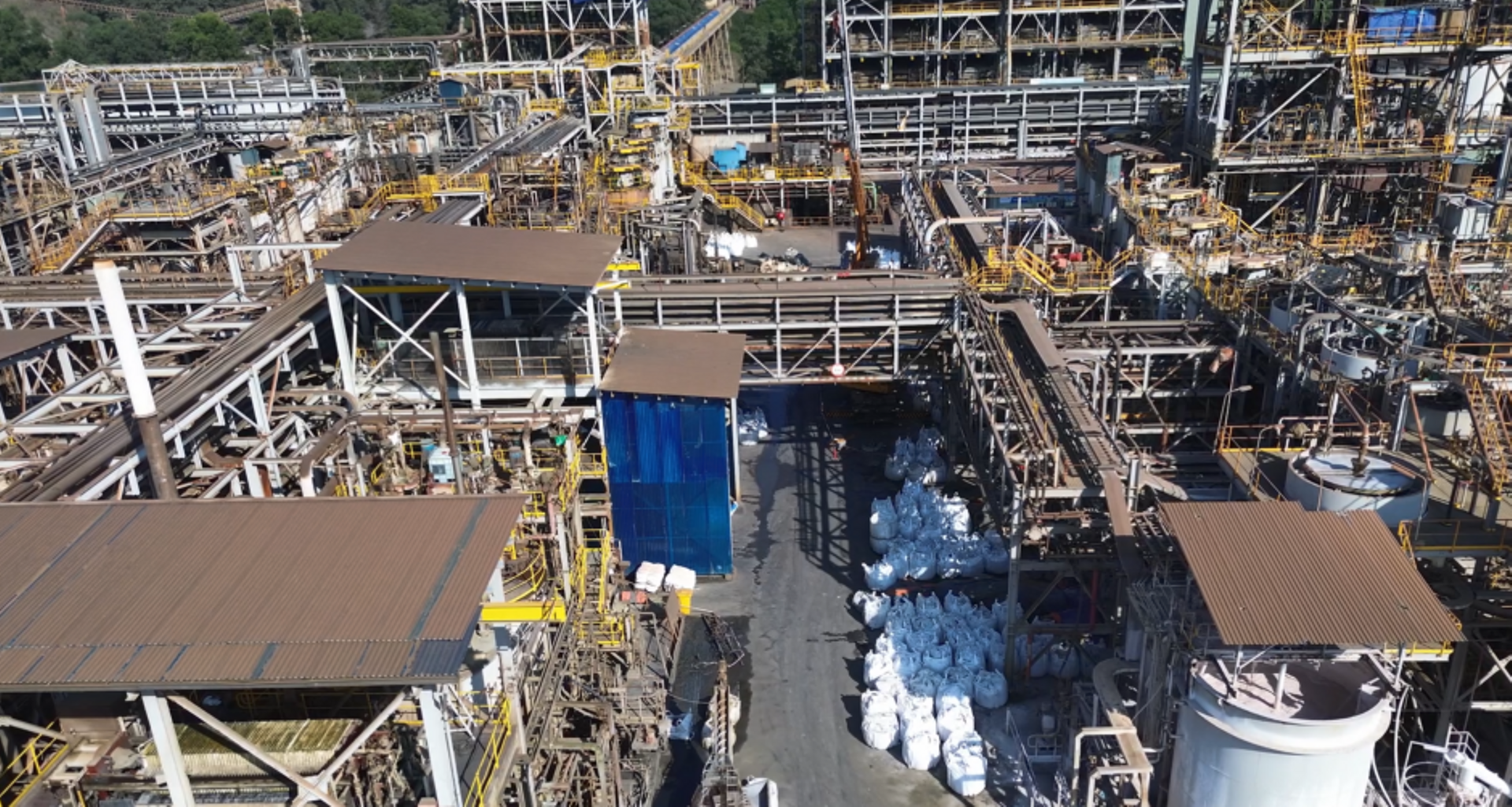
Masan High-Tech Materials (MSR), a global supplier of tungsten and other minerals, is in discussions with potential strategic and financial investors as its parent company, the Vietnamese conglomerate Masan Group, considers divesting up to 5% stake, amid global efforts to secure critical mineral supply chains beyond China.
As part of the divestment, the Masan Group has already completed the sale of 21.99 million shares of the company listed on the Hanoi Stock Exchange’s Unlisted Public Companies Market (UPCoM) trading platform. This is equivalent to 2% of the mining company’s outstanding shares.
While the transaction is primarily aimed at meeting public company requirements and supporting MSR’s planned transition to the Ho Chi Minh City Stock Exchange (HOSE), the company said the move could also help broaden the shareholder base and improve access to institutional investors, a company representative told DealStreetAsia.
The company added that it remains open to welcoming strategic partners that can help create long-term value for both the businesses and shareholders.
The move comes as international interest in MSR continues to grow amid efforts by major economies to diversify critical mineral supply chains away from China.
According to Michael Hung Nguyen, Deputy CEO of Masan Group, strategic investors from Japan, Australia, Europe and the United States have approached MSR in recent months. The interest spans financial institutions, investment funds and high-tech industrial companies seeking long-term, traceable and reliable tungsten supplies from outside China.
Tungsten has become increasingly important in semiconductors, power electronics, defence applications and advanced manufacturing. However, global supply remains heavily concentrated in China, which has tightened export controls and prioritised domestic demand.
Against this backdrop, MSR has emerged as one of the few scaled tungsten producers outside China.
The company’s key asset is the Nui Phao mine in northern Vietnam, widely regarded as one of the world’s largest tungsten deposits outside China. According to industry data previously disclosed by the company, MSR accounts for approximately 21% of global tungsten supply outside China.
MSR accounts for approximately 21% of global tungsten supply outside China.
The company’s strategic relevance has attracted growing attention from policymakers as well as industry players.
In late 2025, German Parliamentary State Secretary at the Federal Ministry for Economic Affairs and Energy Stefan Rouenhoff, together with executives from leading German corporations, visited MSR to learn more about the Nui Phao project as Germany seeks to strengthen critical mineral supply chain security.
For many investors, the attraction extends beyond mining economics. As artificial intelligence infrastructure, advanced semiconductors and defence spending accelerate globally, demand for critical minerals is becoming increasingly linked to industrial policy and supply chain resilience.
“Critical minerals are no longer simply a mining story. They have become a national security issue and a key component of the global technology race,” Masan Group CEO Danny Le said. He added that MSR should not be viewed solely as a tungsten mining company, but rather as a strategic materials platform supplying industries ranging from AI chips and defence technologies to advanced manufacturing.
Riding the AI and defence boom
The investment case for tungsten is increasingly being shaped by forces extending well beyond traditional commodity cycles.
As billions of dollars flow into artificial intelligence, advanced semiconductors, aerospace and defence, investors are beginning to focus on a new bottleneck: access to critical minerals.
Tungsten is used in power semiconductors, aerospace components, precision manufacturing equipment and military systems. As demand for AI infrastructure, electrification and advanced manufacturing accelerates, the metal is increasingly viewed as a strategic asset rather than a conventional industrial commodity.
Tungsten is used in power semiconductors, aerospace components, precision manufacturing equipment and military systems.
Supply, however, remains highly concentrated. According to CNBC, the US has not operated a commercial tungsten mine since 2015, even as demand rises for applications ranging from fighter jets and missile systems to armour-piercing munitions. China continues to dominate both production and refining, and has tightened export controls in recent years, contributing to record tungsten prices.
At the same time, Asia is entering what some investors describe as its strongest industrial investment cycle in two decades, driven by AI infrastructure, energy transition and defence spending.
Re-rating potential
Beyond the structural supply-chain story, investors are also paying closer attention to the improving fundamentals at MSR.
The company reported NPAT Pre-MI of 537 billion Vietnamese dong ($20 million) in the first quarter of 2026, compared with a loss of 222 billion Vietnamese dong a year earlier, marking the highest quarterly profit in its history.
Based on preliminary April performance, MSR’s management estimates that its second-quarter profit could reach approximately 690 billion Vietnamese dong. The outlook for the second half is expected to improve further as ore processing volumes recover following adjustments to the company’s 28-million-tonne mining licence.
Management argues that public markets continue to value MSR primarily as a traditional mining company despite its differentiated position within global critical mineral supply chains.
“We believe the market is increasingly recognising MSR not only as a mining company but as an integrated strategic materials platform,” the company said.
The company’s repositioning has also been reflected in its capital allocation strategy.
In 2024, MSR completed the sale of 100% of Germany-based H.C. Starck Holding to Japan’s Mitsubishi Materials Corporation Group. The transaction is expected to generate around 1 trillion dong in profit while allowing the company to strengthen its balance sheet and focus on core upstream operations.
The divestment did not sever commercial ties between the two parties. MSR and Mitsubishi Materials signed long-term offtake agreements covering APT and tungsten oxide products, while the company also retains exposure to the future commercialisation of H.C. Starck’s black mass recycling technology.
While Masan has reiterated that MSR remains a core strategic asset, the company said future partnerships will be evaluated based on their ability to create long-term value and contribute more than just capital.